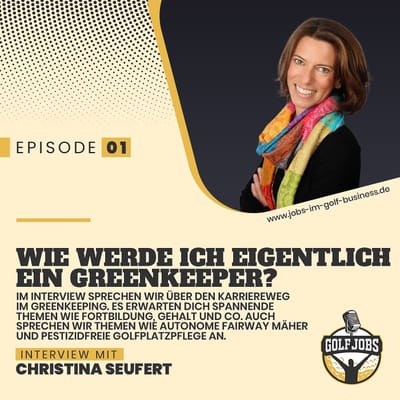
From geographer to greenkeeper association leader
Christina Seufert's childhood dream was geography. From the third or fifth grade it was clear to her that she wanted to study it, above all out of a love of maps. In her studies it was then less about maps than about the view of the big picture, a professor put it in a nutshell: you know a little about a lot, bring in the experts and understand the connections. That fit her broad curiosity exactly. She wrote her thesis about snowboarding and tourism, the sport stayed a common thread.
Only late did she come to golf herself, heard along the way that it is a field of its own and became a golf facility manager. For 15 years she ran facilities, in between lay two years in industry, she did the golf business administrator qualification at the DGV and was active in the golf management association. When the management of the German Greenkeepers' Association became free in 2015, a circle closed for her: away from management, back to what actually happens on the course, to sustainability, course maintenance and the question of how the association can support greenkeepers in doing their job well.
What is a greenkeeper actually?
Greenkeepers work in the sports-turf area, that is the simplest definition. At a golf facility the hierarchy is usually tiered: course workers do the simpler tasks such as mowing, the greenkeeper is the next level, and the head greenkeeper runs the entire outdoor area, from the machines to course maintenance. Course maintenance is the biggest budget of a golf facility and at the same time its flagship, because in the end a facility is measured by the course on which players spend their four or five hours.
The responsibility goes far beyond mowing and fertilising. A good greenkeeper does not apply plant protection products reflexively as soon as a disease shows, but works sustainably with the available resources, protects biotopes, pays attention to environmental protection and understands their facility as an ecosystem of its own.
Technology and digitalisation in greenkeeping
On the topic of technology, Seufert gets going. Weather stations record temperature, precipitation, solar radiation and humidity. Ideally these measuring devices are coupled with the irrigation, so it knows where it rained how much and automatically irrigates only where necessary. The irrigation itself can today be controlled by app, each individual sprinkler separately, without anyone having to go into the field with a wrench. That saves water and targets the dry spots precisely.
Add greenkeeper software solutions that replace handwritten Excel lists and timesheets. Today the employee logs in by app, documents work steps, machine use and material consumption. The result is a clean documentation of who did what when with which product, an enormous leap compared with the lists of the past.
Autonomous mowing: from the ride-on mower to the robot
The most exciting trend for Seufert is autonomous mowing. The technology originally comes from agriculture, where GPS-controlled machines have long been standard. By now manufacturers convert ride-on mowers so that they hold their track GPS-supported themselves, with clearly defined areas in which they may drive. Anyone who is unfocused in the morning no longer accidentally mows right across the rough with it. Fertilising can also be controlled so that no area is fertilised twice, which conserves resources and protects the turf from overfeeding.
Alongside this there are steering aids that are not fully autonomous: the employee still sits on top, but the programmed track runs automatically, they can intervene at any time. Still relatively new are oversized robots, comparable to the small mowers from the home garden, only big enough for the fairway. They can work unsupervised, mow at night without lighting and, electrically powered, so quietly that residents notice nothing. Legally much of this is still in flux, and the purchase is expensive. But for Seufert it is clear that the model will catch on, comparable to the autonomous ball collectors on the driving range that are likewise already out and about.
How do you become a greenkeeper?
There is no direct apprenticeship to become a greenkeeper in Germany. The ideal entry is a green occupation such as landscaping and gardening. Building on this, the two Deula schools in Freising and Kempen offer further training to become a greenkeeper and head greenkeeper. Which of the two schools fits is decided above all by the dates, in content both are comparable. Seufert expressly recommends this further training, because it conveys not only the routine but opens the view: for sustainable maintenance, for alternatives to the classic use of products and for the fact that every facility is different and no blanket maintenance prescription fits everywhere.
Anyone who becomes a head greenkeeper additionally enters a leadership role: budget responsibility, staff leadership, occupational safety and not least communication. Precisely because today fewer plant protection products are used and more is done mechanically, for example through sanding and aeration, the head greenkeeper has to explain to their board why which measure is necessary, and make clear to the golfers why the facility is temporarily restricted. It is exactly this ability to explain that greenkeepers now learn too.
What you take away from the conversation
- Several routes lead to greenkeeper, ideal is a green occupation plus Deula further training
- The career goes from course worker through greenkeeper to head greenkeeper or course manager
- Technology such as GPS steering and app irrigation saves resources but does not replace professional judgement
- Climate change makes the work more demanding, from drought to local storms
- Appreciation and fair pay are decisive so the profession stays attractive
What a greenkeeper earns
A blanket figure is hard for Seufert, because the gradient within Germany is clear. In the new federal states tends to be paid less than in conurbations such as Munich or Cologne. The online available ranges that Mirco mentions in the conversation she can confirm: a greenkeeper earns gross between around 1,900 and 3,200 euros a month, on average about 2,500 euros. For the head greenkeeper it starts at about 3,500 euros gross, upwards five-figure salaries are possible. Anyone who has completed a Deula further training should as a greenkeeper in any case be above 3,000 euros gross.
A golf facility is ultimately measured by the course. The greenkeeper is responsible for exactly that.
Climate change at the golf facility
The last summers have noticeably hit the industry, from parched courses to short, heavy thunderstorms after which facilities stayed closed for a long time. A shortage of water forces a rethink, towards well construction, towards cleverer irrigation and overall towards more sustainable maintenance. The association takes up the topic regularly at conferences and drives the exchange with the other golf associations so that solutions arise together.
The German Greenkeepers' Association
The GVD is a recognised professional association with over 1,000 members, including greenkeepers, head greenkeepers, course workers, golf clubs and companies from the industry. Six regional associations keep the contact locally, plus nationwide conferences, field days, workshops and by now also webinars. Internationally the association works with the FECA on sustainability projects and cooperates closely with the greenkeeper associations in Austria and Switzerland. Internally the GVD provides template contracts, worksheets and specialist information that are continually updated, and develops new templates on request.
What keeps her up at night: respect for the profession
Asked what occupies her, a clear answer comes: respect. In greenkeeping too there is a shortage of skilled workers, fewer young people want to take up the profession, and some who love it as a calling stop at some point because the pressure gets too great. Frequent board changes, cut budgets and changed weather conditions hit greenkeepers hard, plus the feeling of sometimes only being in the way on the course. Seufert wishes that golf facilities industry-wide deal more respectfully with their staff, that fair jobs arise and that the pay matches the knowledge and the responsibility. Until then, she says, it is a long way, but it is exactly that which is a matter of the heart for her.
What she would advise her younger self
On the lessons of her own career Seufert looks clearly. The most important thing was the exchange with colleagues. Through the golf business administrator at the DGV and the meetings of the golf management association she built her network, and decisive were often not the talks but the conversations in the breaks and over dinner. Knowing that others have the same worries helps. Over the years she has also become considerably more relaxed. Earlier she saw things more grimly and perfectionistically, today with more distance, without taking them less seriously. Listening to staff and dealing respectfully with them is what she would have wished for more often at the start.
Conclusion
Greenkeeping is long since no longer a pure lawnmower job but a specialist profession with responsibility that becomes more demanding rather than superfluous through technology and climate change. Anyone who likes working outdoors, brings an affinity for nature and is ready to train further via the Deula schools finds a future-proof field with real career prospects here. For this picture to land in the industry itself, it needs exactly what Seufert keeps demanding: more appreciation and fair conditions.