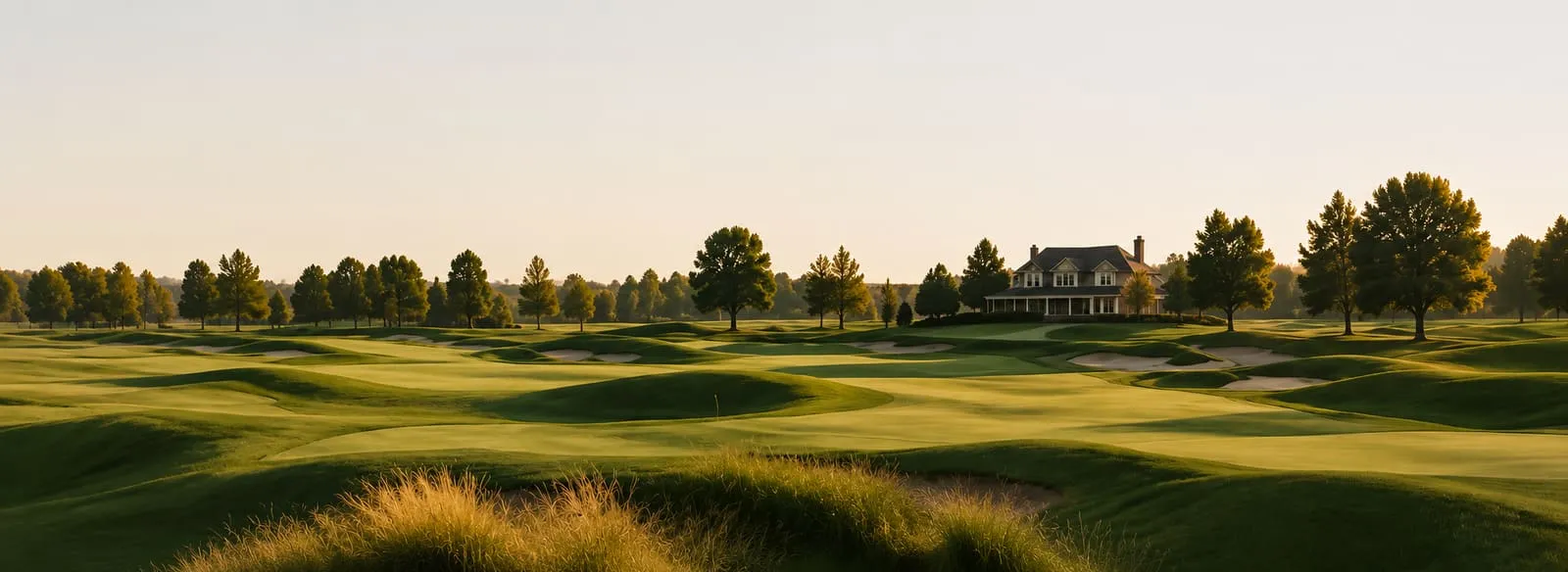
When you walk over a well-kept course, you probably think about your game, about the line to the hole or about the next tee. What you rarely see is the work behind it. Because a lush green does not arise on its own. Behind it stands a team that reads the weather, understands soil, operates machines and plans across the whole year. Greenkeeping is the heart of a golf facility, and that is exactly what we look at more closely here.
A golf facility is judged in the end by its course. That is where players spend their four or five hours, that is where it is decided whether they come back. Course maintenance is therefore the biggest budget and at the same time the most important promise to the guest. Anyone who wants to work in the golf business should understand what actually happens on the course.
Greenkeeping across the year: a job with four seasons
Greenkeeping follows the calendar. There is no season in which nothing is to be done, only different priorities.
In spring the course ramps up. The greens are brought back into shape, the first mowing runs, the irrigation is put into operation and checked for leaks. It is the phase in which the winter's care becomes visible.
In summer the daily routine takes centre stage. Early in the morning, often before the first golfers, greens are mown, flags moved, bunkers raked and dry spots watered in a targeted way. Heat and drought make these months demanding, because the turf is under stress and every measure has to be right.
In autumn the focus shifts to preparation. Leaves have to come off the playing surfaces, pump houses and sanitary facilities are made winterproof so that no pipe freezes. At the same time, important maintenance measures such as aeration and topdressing run, which do the soil good for the next season.
In winter the course rests, but the team does not. Trees are pruned and shredded, old tree stumps dug out, benches painted, tee markers cleaned and the entire fleet serviced. When the next spring comes, everything should be ready.
Agronomy and turf: what happens under your feet
Behind every green sits agronomy, the knowledge of how soil, grasses, water and nutrients interact. In golf people often speak of turf, the sports lawn as a system of its own made up of plant and root zone. Sounds technical, but is easy to understand once you break it into its building blocks.
Grasses. Not every lawn is the same. Depending on climate, soil and playing surface, different grass species are used, and a green needs a completely different mix than a fairway or the rough. The greenkeeper has to know the grasses, assess their properties and recognise when something gets out of balance.
Mowing. On the green it is mown extremely short, often in the millimetre range, so the ball rolls cleanly. This short cutting height puts the plant under permanent stress, which is why mowing is never just about looks but a tightrope walk between playability and plant health.
Aeration. Compacted soil gets too little air and water to the roots. In aeration the lawn is punched through with hollow or solid tines so it can breathe again. For a few days the green looks unusual afterwards, but that is exactly what keeps it healthy in the long run.
Topdressing. After aeration, fine sand is applied and worked in. That levels the surface, improves the structure of the soil and over time ensures a more even, faster playing surface.
Fertilising. The lawn needs nutrients, but in the right dose. Too much leads to excessive growth and diseases, too little to bare patches. Good fertilising is fine work, attuned to grass species, weather and soil analysis.
Agronomy at a glance
- Turf is more than lawn: plant, soil and root zone form a system
- Mowing, aeration, topdressing and fertilising mesh together
- Mechanical care increasingly replaces the reflexive use of products
- Every facility is different, there is no blanket maintenance prescription
Irrigation and water management: the scarce resource
Hardly any topic occupies golf facilities as much as water. Dry summers have parched whole courses in recent years, and at the same time water is becoming more expensive and scarcer. Good water management is therefore long since part of the core competence in greenkeeping.
Efficiency here means watering only where it is really necessary. Weather stations measure temperature, precipitation, solar radiation and humidity. Ideally these data are coupled with the irrigation, so the system knows where it has rained and automatically supplies only the dry spots. Modern irrigation can today be controlled by app, each individual sprinkler on its own, without anyone having to go into the field with a wrench.
In addition there are structural answers to the scarcity, such as the facility's own wells or storage ponds that make it more independent of the grid. The goal is always the same: to maintain, with as little water as possible, a course that stays playable and healthy.
Sustainability: biodiversity and resources in view
A good greenkeeper understands their facility as an ecosystem, not as a pure playing surface. That means working with the available resources, protecting biotopes and not reaching reflexively for the plant protection product as soon as a disease shows. Instead, mechanical care moves to the foreground, for example through sanding and aeration, combined with targeted fertilising and a clever water strategy.
Biodiversity plays a bigger role than many think. Between the holes there are often near-natural areas, hedges, ponds and lean meadows that offer habitat for insects, birds and other animals. A golf facility can thus become a surprisingly species-rich landscape if these areas are deliberately maintained and not everything is kept short.
As a term for structured sustainability in golf, the GEO certification has become established. It stands for a programme that accompanies golf facilities in systematically improving their handling of nature, resources and surroundings and making it transparent. For facilities it is a way to not only claim sustainability but to demonstrate it comprehensibly.
Machines and equipment: the engine room of the facility
Greenkeeping is also a technical profession. The machine fleet of a golf facility often holds an astonishing amount, from the special mower for the green through fairway mowers and aerators to sand spreaders, irrigation pumps and a whole fleet of vehicles and attachments. These machines want to be serviced, repaired and maintained across the year, which is a large part of the work especially in winter.
What is exciting is how strongly this area is currently changing. Ride-on mowers can today be converted with GPS support so that they hold their track themselves and drive within clearly defined areas. That prevents double-fertilised areas, conserves resources and ensures an even cut. Alongside this there are steering aids in which the employee sits on top and can intervene at any time, while the programmed track runs automatically.
Even newer are large, electrically powered mowing robots for the fairway, comparable to the small mowers from the home garden, only considerably bigger. They can work unsupervised and so quietly that nobody is disturbed at night. Much of this is still legally in flux and expensive to purchase, but the direction is clear. Autonomous ball collectors on the driving range are heading in a similar direction.
Greenkeeping and management: the interplay
As important as the work on the course is, it does not function entirely on its own. Greenkeeping and management have to work hand in hand, because most decisions have two sides: a professional one and an economic one.
The head greenkeeper runs the entire outdoor area, from the machines to course maintenance, and carries budget responsibility, staff leadership and occupational safety. Just as important is communication. Because today more is done mechanically and less with products, they have to explain to the board why a measure is necessary, and make clear to the golfers why the course is temporarily restricted. Anyone who has ever cursed over a punched-through green after aeration knows how much this explanation is worth.
Conversely, it needs a management that understands the value of course maintenance and does not cut the biggest budget at the first pressure to save. Frequent board changes, cut budgets and difficult weather put greenkeepers under pressure. Where management and greenkeeping meet as equals, a course arises that lasts for years.
Frequently asked questions
What exactly does a greenkeeper do?
A greenkeeper maintains the sports turf of a golf facility and takes care of everything that keeps the course playable: mowing, watering, fertilising, aeration, bunker care and the servicing of the machines. Add to that the knowledge of grasses, soil, diseases and weather.
Why is the course so full of holes after aeration?
In aeration the soil is punched through so that air and water reach the roots again. For a few days the green looks unusual, but it is exactly this measure that keeps the turf healthy and fast in the long run.
How do golf facilities deal with water scarcity?
Through efficient, often app-controlled irrigation that supplies only dry spots, through weather data for control and through their own wells or storage ponds. The goal is to maintain a healthy course with as little water as possible.
What does GEO certification mean in golf?
GEO stands for a sustainability programme that accompanies golf facilities in systematically improving their handling of nature, resources and surroundings and demonstrating it comprehensibly.
How do you become a greenkeeper?
There is no direct apprenticeship. The typical route runs via a green occupation such as landscaping and gardening and further training building on it to become a greenkeeper and head greenkeeper. More on this you find under golf education and training.