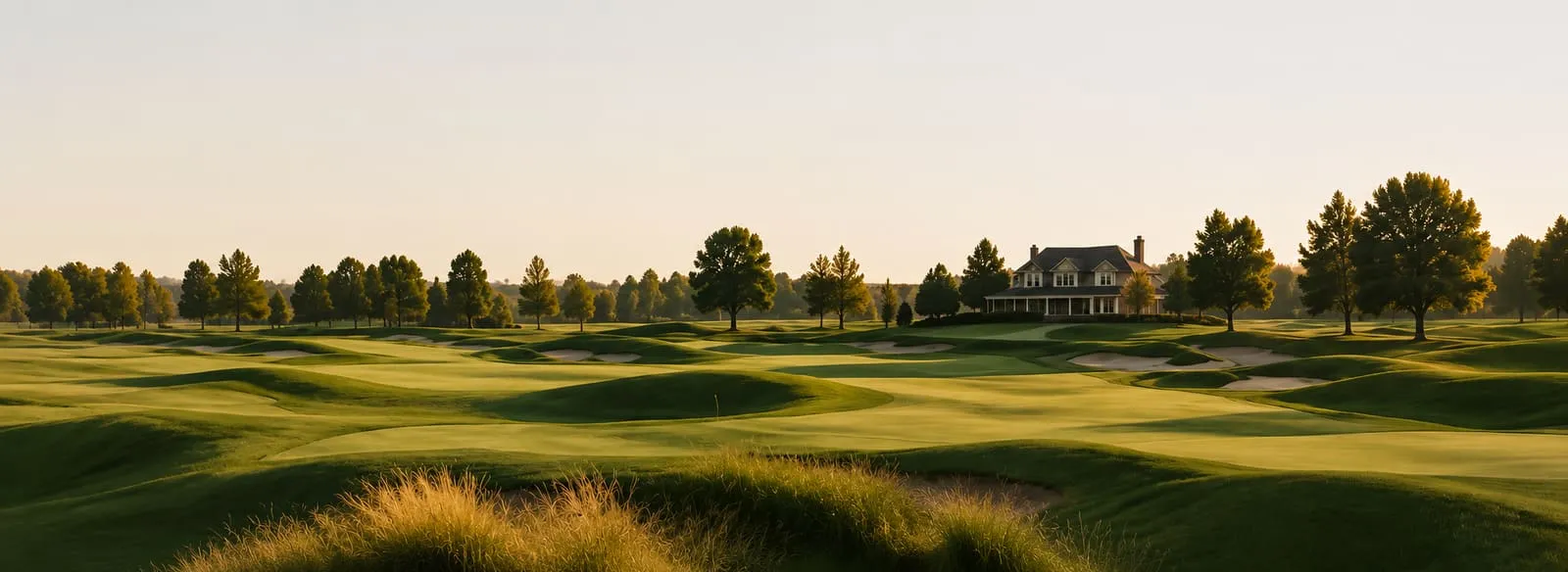
A golf facility ages like a good wine, Tim Steffens told me in the interview about founding his facility. Trees grow, the small ecosystem matures, and after 25 years hardly anything of the former farmland can be recognised. That is exactly why construction is so exciting: here you lay out a landscape that will be played, maintained and rebuilt again and again over decades. In this article I go through the path from design to finished facility with you.
The essentials up front
- The golf course architect translates terrain, nature conservation and the playing idea into a routing and 18 (or 9) holes.
- The planning phases run from site and permit through the routing to the detailed design of the holes.
- New build means shaping a landscape, renovation means modernising an existing facility during ongoing operations.
- Drainage and irrigation are the invisible backbone, without them no permanently playable course.
- After completion the greenkeeping takes over, which is what brings the course to maturity.
The role of the golf course architect
At the start stands a person who has a piece of land in front of them and sees a round of golf in it. The golf course architect is exactly that: someone who thinks terrain, soil conditions, nature conservation requirements and a playing idea together and forms a facility from them. It is not about placing 18 holes somewhere, but about arranging them so that a round offers tension, rhythm and fair challenges, and that at every playing level.
A good architect works with the terrain, not against it. A natural hollow becomes a water hazard, an existing ridge the backdrop for a raised green, an old stand of trees a strategic element. The more of the existing landscape is preserved, the cheaper the earthworks and the better the result often is. Add the strategic thinking: where may the long shot be rewarded, where does a bunker force a decision, how does the hole play in wind, how in rain.
The planning phases: from idea to plan
Before the first digger rolls, a lot of time often passes. The planning runs in several stages that build on each other.
Site and permit
First the site has to be right. Decisive are the size and shape of the area, the soil condition, the water availability and the location relative to the target group. In parallel begins the often most protracted part: the permit. A golf course is an intervention in the landscape, so development plan, environmental assessment, nature conservation and water law come into play. Authorities, conservation associations and residents have a say. This phase can drag on for years, for Tim Steffens five years lay between the first plans in 1989 and the opening in 1994.
Routing
The routing is the heart of the architecture. Here the architect determines how the holes run across the terrain, in which order they are played and how they lie relative to each other. A good routing uses the terrain optimally, avoids dangerous crossings of flight paths, ensures short distances between green and the next tee and creates a varied rhythm of short and long holes. Often several variants arise here, which are played through and discarded until the best solution stands.
Design of the holes
Once the routing stands, it goes into the detail of each individual hole. How wide is the fairway, where do the tees for various playing standards lie, how is the green shaped and sloped, where do bunkers and hazards sit. Here the character of the course is decided. The question of whether the facility is to be expanded later also belongs in this phase, with Steffens 27 holes are approved in the development plan to this day, but because of the cautious start only 18 were built initially.
New build or renovation
Not every construction project is a new build on a greenfield. Roughly, two routes can be distinguished.
In a new build a complete facility arises from scratch. That means large earthworks, new routing, new irrigation, new infrastructure from the driving range to the clubhouse. The effort is high, but there are hardly any restrictions from the existing. New builds have become rare in Germany, the great boom of the 1990s, when 42 facilities opened in 1994 alone, is over.
In a renovation or rebuild, an existing facility is modernised. That ranges from the rebuild of individual greens through the renewal of the irrigation to the complete re-design of individual holes. The big challenge: play often continues. This is exactly where the operational advantage of larger facilities shows, anyone who can close nine holes for maintenance or construction phases and offer 18 in parallel has it considerably easier. Many German facilities today face exactly such renovations, because irrigation systems and greens from the 90s are reaching the end of their life.
Bunker and green construction, drainage and irrigation
When the earthworks have formed the rough terrain, the fine work begins, and that decides the later quality.
The green construction is the most demanding discipline. A green is not a simple lawn but a precisely built layered body of drainage, gravel, a special bearing layer of sand and substrate, and the turf on top. This construction ensures that water drains off in a controlled way and the green stays playable even in rain. The shape and slope of the green are among the architect's finest tools.
The bunker construction combines looks, strategy and maintainability. A bunker has to look good, intervene in play at the right spot and be sensibly maintainable later. Drainage is a must here too, otherwise water stands in the sand after every downpour.
Drainage and irrigation are the invisible backbone of the whole facility. The drainage carries off excess water, the irrigation brings it in dry phases exactly where it is needed. Modern systems work with sensors and individually controllable sprinklers to save water. Where the water comes from, well, pond, storage basin, is a central question that has to be clarified already in the permit phase.
Sustainability and permits
A golf course today is no longer a pure sports ground, but also a piece of natural space, and that is exactly how it is seen by authorities and the public. Nature conservation and water law are therefore not a tiresome obligation on the side but co-determine the project from the start.
With nature conservation it is about preserving and partly upgrading habitats. A well-planned facility creates hedges, ponds, lean grassland and unmown rough zones that give space to insects, birds and amphibians. Such compensation areas are often a condition of the permit, and they make the course more varied along the way.
With water the question arises of where the irrigation comes from and how sparingly it is used. The extraction from groundwater or bodies of water requires a permit, and especially in dry summers the topic becomes sharper. Storage basins that catch rainwater and sensor-controlled irrigation are the answer with which modern facilities score.
After completion: the greenkeeping takes over
With the construction handover the work is not over, it actually only begins. A freshly built course is far from a mature course. The turf has to grow in, the greens need time until they have the necessary density and firmness, and the whole ecosystem only settles over years.
The greenkeeping handles this transition. Even in the construction phase the later head greenkeeper should be involved, because they have to maintain the facility afterwards and know the pitfalls from practice. How closely construction is interlinked with the later maintenance shows in every detail: a bunker shape that looks nice in the plan but cannot be reached with the maintenance machine becomes a permanent annoyance. What good greenkeeping achieves after completion I describe in detail in the article on golf course maintenance and greenkeeping.
Time and costs: as orientation only
There is no serious blanket figure for building a golf course, and I will not invent one for you here. Terrain, soil conditions, permit requirements, irrigation technology and equipment are too different. A renovation of individual greens is in a completely different order of magnitude than a complete new build with earthworks, irrigation and clubhouse.
As rough orientation: the planning and permit phase can drag on over several years, the pure construction time of a new build often moves in the range of one to two playing seasons, and until a course is really maturely playable, further years pass. Anyone who needs reliable figures for a concrete project cannot avoid individual planning with an architect and specialist planners. How such investments pay off and can be financed is a big topic of its own, you find more on it under viability and financing of a golf facility.
Frequently asked questions
How long does building a golf course take?
That depends strongly on the project. The planning and especially the permit can drag on over several years, the pure construction time of a new build is often in the range of one to two playing seasons. Until a course is really mature, further years pass after that.
What does building a golf course cost?
There is no serious blanket figure, because terrain, requirements, irrigation and equipment determine the price. A single green renovation costs a fraction of a complete new build. Reliable figures are only delivered by individual planning with an architect and specialist planners.
Who plans a golf course?
The design is the responsibility of the golf course architect, who brings together terrain, nature conservation and the playing idea. Add specialist planners for irrigation, earthworks and civil engineering, the site management and, in the end, the greenkeeping that takes over the facility.
Why does the permit take so long?
A golf course is an intervention in the landscape. Development plan, environmental assessment, nature conservation and water law have to be clarified, and authorities, associations and residents have a say. This participation takes time but can be shortened by early and open planning.