
A while ago, a post by Golfclub Schloß Frauenthal from Styria in Austria crossed my path on Instagram. In its reel, the club wrote, in essence, that golfers should of course dress reasonably appropriately, but that sport is above all about removing barriers and having fun. Jeans and a t-shirt are therefore perfectly fine on their course. I found that likeable and was about to scroll on. But then my eye got caught in the by now rather long comment section. Dozens of golfers spoke up, many of them visibly upset about the Austrian club's policy.
I read through the comments and discussions under the Instagram post, but one crucial thing was missing. What was it? An argument that would explain to me why these blue jeans of all things trigger so many negative emotions among our golfers.
What the Comment Section Said
To give you a better impression of the discussion about jeans on the golf course, here is a small glimpse into the comments there. There were voices both for and against the jeans. The comments are translated from German.
Team Dress Code
- "Seriously? Jeans??? On a golf course? Absolutely not, in my opinion!"
- "It is wonderful to go to the golf course and be surrounded by polite, properly dressed people. Anyone who cannot even follow a clothing etiquette obviously makes little effort when it comes to rules."
- "Complete nonsense. Etiquette is part of the sport. A polo shirt and proper golf trousers are mandatory for me. Respect for the sport… otherwise soon you will have people in tank tops from the beach bar and short denim pants with a fanny pack…"
- "Anyone who has a problem with the rules and etiquette should find another sport. I don't go to the theatre in swim shorts and slides either."
- "Etiquette is simply etiquette…"
- "It is not called 'tradition' for nothing, so it should be preserved. I don't wear football boots to a football match either."
- "A certain etiquette has nothing to do with elitism or exclusion. I don't know anyone who doesn't play golf because they can't wear jeans. Especially since golf clothing is available from expensive to cheap."
- "It would have been smarter to promote the beginner's course and point out that you don't need special clothing for it, sneakers and jeans are enough. So, enough free consulting for today 😉"
- "And next time in hotpants and a tank top? A collared shirt and trousers without holes are the minimum you can expect on a golf course. The same goes for the range."
- "Does a swimsuit work too? Topless?"
- "A t-shirt maybe, but jeans are totally unsuitable in terms of material."
- "A shirt for a casual round (no tournament etc.) is ok, but jeans really go too far. Sorry, why not a tracksuit right away? Best to scrap the rules of golf entirely so nobody gets frustrated."
- "Not tradition, etiquette. It doesn't have to be expensive, but jeans and a t-shirt are simply a no."
- "I think your post completely backfired."
- "It is not about expensive brands, it is about appearance. If the polo from a discount store fits, that is perfectly fine, at least it has a collar. And jeans are completely unsuitable anyway."
- "Jeans are uncomfortable for walking 6 to 10 km. On 95% of the courses I have played (Europe, Asia), jeans and a t-shirt would not be allowed. A certain dress code also has something to do with respect for this sport. 🤗"
- "Sportswear is functional, the boys on the football pitch don't play in their casual clothes either… 😍 although I am happy that golf fashion has become much more colourful. 😂"
- "I agree, it's etiquette. You don't play ice hockey in jeans either."
- "I just find it sad to destroy centuries-old traditions, because you can never bring them back! And for what exactly?"
- "Absolutely not!!! Jeans are frowned upon ‼️ You want to drag the sport down to pub level ‼️ You can do that, but not nationwide."
- "😱 and a tracksuit with slides 😱"
- "In some clubs, like mine, they check and throw you off the course if you are not wearing a polo or golf trousers. I speak from experience."
- "Absolutely no jeans on the course…"
- "Jeans, t-shirts, hotpants or tank tops are an absolute NO-GO… Go play minigolf or TopGolf in those outfits. Anyone who has a problem with that is simply not suited to this sport."
- "Golf should definitely become more of a sport for everyone. But you won't achieve that with blue jeans and a t-shirt. Golf is a sport! I am team golf etiquette."
- "Please no!!! It won't take long until people walk around in sweatpants and hoodies. With the hood up, of course. Style is an expression of sophistication. Decent golf clothing doesn't cost a fortune, ugly sweatshirts with oversized logo prints do."
- "For first-timers trying golf for the very first time, I think it's fine. But once we are golfers, I would prefer appropriate athletic clothing."
- "Then I won't go there. Whoever can't afford golf clothing should play minigolf! Very bad advertising for selling green fees."
- "NO… you canNOT 👖👎"
- "So TopGolf level at your place, where anyone can hack around. Okay. Is the beginner's certificate the next thing to fall victim to your madness?"
Team Just Play Golf
- "Totally agree. I don't get the hate against jeans at all, combined with a polo it's a perfectly good compromise."
- "Great, finally someone says it! 👏"
- "So true 🔥"
- "Tradition called and wants you to play with hickory clubs and balata balls. Oh, and by the way, women aren't allowed in the clubhouse either, same for people of colour. Don't make golf harder than it is, repair your pitch marks, be quiet and respect your fellow players and the course. Worth far more than FJ trousers and a Titleist cap."
- "Funny, Tiger played in a t-shirt."
- "Even the pros play in t-shirts."
- "What is it with all of you and the collar? Ever watched the pros? You can even play on the PGA Tour without a collar."
- "Right, wearing jeans makes you rude and ill-mannered 👍 people who wear jeans should just be banned from every sport, they never follow any rules anyway."
- "Who cares what people wear, apart from trolls and miserable, insecure people? 🤷♂️"
- "I have never had any problems in jeans in fair, mostly dry weather. I do it often."
- "I have several tour players and former tour players in the clubs around me and we have played together a few times. If even they walk around in jeans and a hoodie, why should I care what some prissy Herbert and Karen with a handicap of 30 think?"
- "I play golf too and don't wear jeans because they are uncomfortable. But why does a shirt always need a collar? Just relax and enjoy your golf. Without the beginner's certificate there is no golf anyway 🏌️"
- "My English friend on Tenerife once said: 'The Germans, always great equipment and perfectly dressed. But they can't play.' Shouldn't we first get people onto the course who might have talent? The dress code sorts itself out later."
- "I find it amusing how everyone here is whining about a pair of jeans. I know people who ride downhill trails in jeans and pull off tricks. And who says 'you must play in jeans'? All that is being said is: don't stress about what you wear. Just play golf."
- "Look at this comment section and understand why golf has a youth problem and only retirees walk the courses."
- "Everyone acts as if someone in jeans and a t-shirt is somehow holding them back. Why do you care what someone else wears?"
- "♥️ You are 100% right. The most annoying thing about golf is the outdated dress code. I believe it is one reason golf still has this bad reputation."
My point here is explicitly not to expose either side. Something else interests me. Because where does so much emotion come from on a topic as simple as a pair of jeans?
A Déjà-vu You Probably Know
To me, this debate honestly felt strangely familiar. The emotionally charged discussion about the pros and cons of jeans on the golf course strongly reminded me of debates like the one about a speed limit on German motorways. Or even the gun debate in the USA. And even though it seems to be about a rather neutral thing at first glance (a pair of trousers, a speed, a law), it was probably really about something much bigger. About what, you ask?
More on that in the conclusion of this article.
In this article, I don't want to preach either, because personally I could not care less what you wear on the golf course. If you feel best in an ironed polo with pleated trousers, that is wonderful. If you prefer teeing off in stretch jeans, so is that. Given how emotionally this debate is held, I just want to think out loud about a few questions that have stayed with me since that comment section. So let us look at the individual arguments one by one and check how solid they really are.
What Do the Official Rules of Golf Actually Say About Clothing?
Before losing myself in the many opinions of the comments, I first wanted to know what is actually written in the rules about jeans and dress codes, in black and white. And that is where the research surprised me a little for the first time.
The word "etiquette" has in fact not appeared in the official rule book since the big rules modernisation of 2019. The former "Etiquette" section was replaced by Rule 1.2 "Standards of Player Conduct". You can read about it at the USGA and at the German Golf Association.
Rule 1.2 names three core principles:
Rule 1.2 in Short
Integrity. Play honestly, follow the rules, take no unfair advantage. Consideration for others. Play at a prompt pace, watch out for safety, shout "Fore!" when there is danger, don't distract other players. Care for the course. Replace divots, rake bunkers, repair pitch marks.
Do you notice anything? No polo shirt. No collar requirement. No fabric specifications. Clothing simply does not appear in the official conduct standards of the sport of golf. That is particularly interesting because etiquette was cited again and again in the comments as the reason why a polo shirt is necessary and blue jeans are not.
And something else surprised me. This was already the case before 2019. The old etiquette section in the R&A or USGA rule book did cover safety, consideration, pace of play and care for the course, but not the dress code. So a clothing code was not part of it there either. Dress codes lived and have always lived somewhere else, namely in the house rules of the clubs, in tournament conditions and in the regulations of the professional tours. The rules explicitly allow every club to set its own "Code of Conduct" and to sanction violations individually. Up to and including being sent off the course.
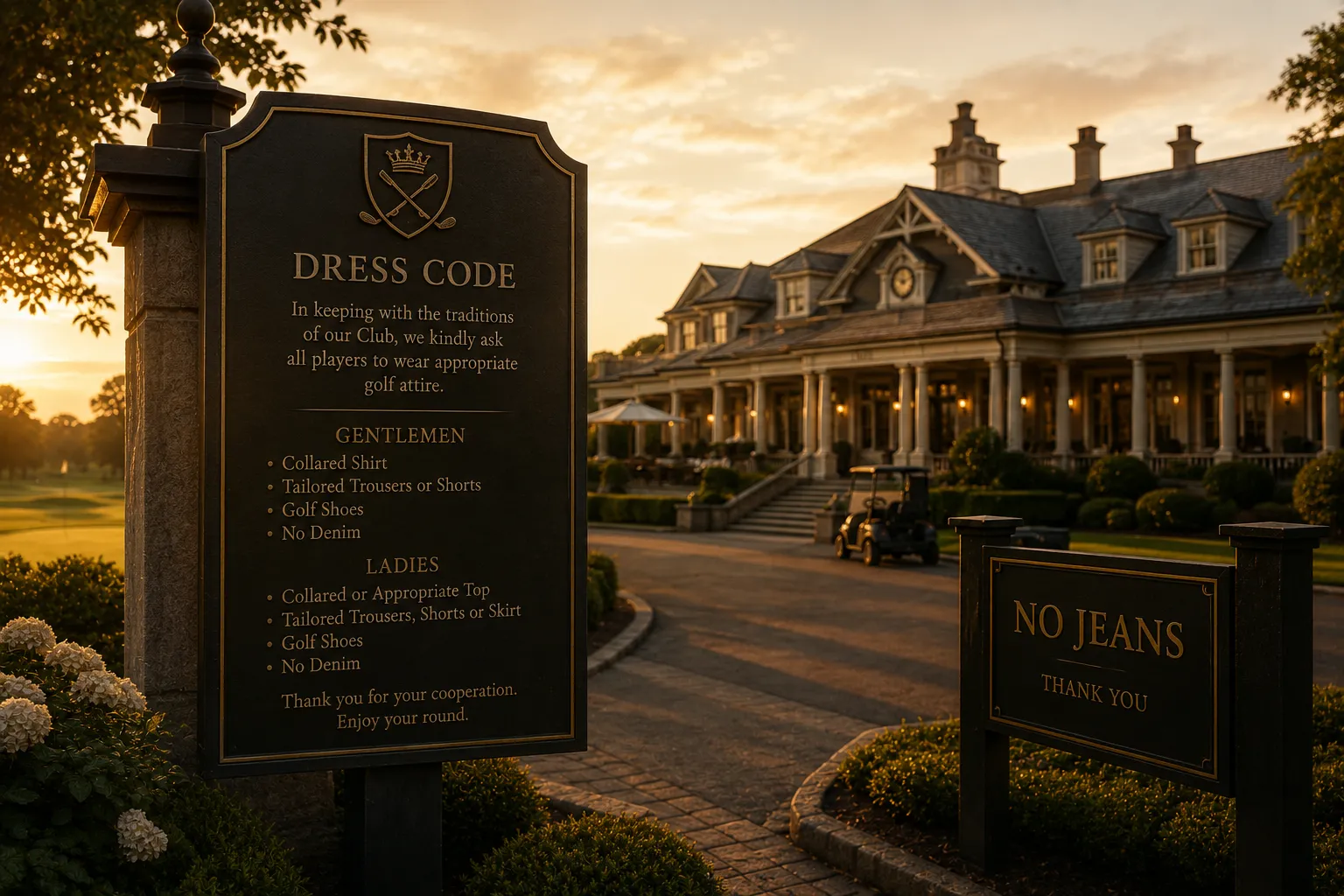
So the sentence "jeans violate golf etiquette" is, if we want to be precise, not quite right. Closer to the truth would be: jeans can violate the dress code of a specific club. That sounds like hair-splitting, but it marks an important difference in the conflict around allowing jeans in golf clothing. One would be a universal norm of the sport. The other is a local house rule.
And a question forces itself on me here. If the highest rule-making body of golf does not mention clothing with a single word, why do so many of us think of jeans and collars first when we hear the word "etiquette", instead of honesty, consideration and care for the course? From my time in greenkeeping and as a ranger on golf courses, I can report, by the way, that exactly those who did not repair their pitch marks or could not be bothered with the bunker rake were almost always dressed in classic golf trousers and a polo.
The Questions I Have Been Asking Myself Since
Because the debate would not let go of me, I spent a while with the thoughts of both sides. I would like to walk through a few of them with you, because each one leaves a question behind that I find fascinating.
Are Jeans Really Impractical? An Argument Against Jeans
The material argument sounds plausible at first. Old, historical jeans were heavy, stiff and a catastrophe in the rain. So at that time, an unthinkable piece of clothing for the sport of golf. But the fabric has evolved over the decades. Modern stretch jeans are elastic, light and for many people more comfortable than some chinos. Internationally, more and more facilities are loosening their rules, among other reasons for exactly that, or at least allow well-kept or dark jeans.
And even if jeans were uncomfortable. Skirts and shorts are allowed almost everywhere, although they too have their drawbacks in golf, from ticks to sunburn. At 35 degrees, jeans are certainly not a brilliant idea, but a black polyester polo probably isn't either. People ride downhill trails in jeans, skate, ride BMX and jump over rocks. Perhaps the most honest answer here is simply that every person knows best what they want to walk six to ten kilometres in. Astonishingly, the sport most similar to golf, hiking, is an outdoor activity that outdoor and sportswear brands like Fjällräven, RevolutionRace, JeansTrack or Alberto supply very well with functional jeans. A look at various hiking routes shows nicely that hikes cover similar or even longer distances than a round of golf. And that with a backpack and elevation gain.

Is Golf Clothing Functional Sportswear Like in Football?
The comparison with football comes up a lot in these discussions as a possible argument. And somewhere I do like this angle on the topic, because it encourages thinking. But if we do exactly that, meaning think about it a little longer, doubts creep in quickly. Football clothing is functional clothing. Studs provide grip, shin guards protect and the shirt distinguishes the teams. Every piece has an athletic purpose.
In golf, golf shoes undoubtedly have a function. But what athletic purpose does a collar serve? What can chinos do that dark jeans or a skirt cannot? If I am honest, I have not found a satisfying answer to this question yet. Maybe there is one. It has not crossed my path so far. Until then, it looks to me as if clothing in football follows function and clothing in golf rather follows habit or even tradition.
Where Does the Tradition Actually Come From?
"It's tradition" is what I hear most often on this topic. And tradition truly is not unimportant to me, quite the opposite. That is exactly why I wanted to know where this particular tradition comes from.
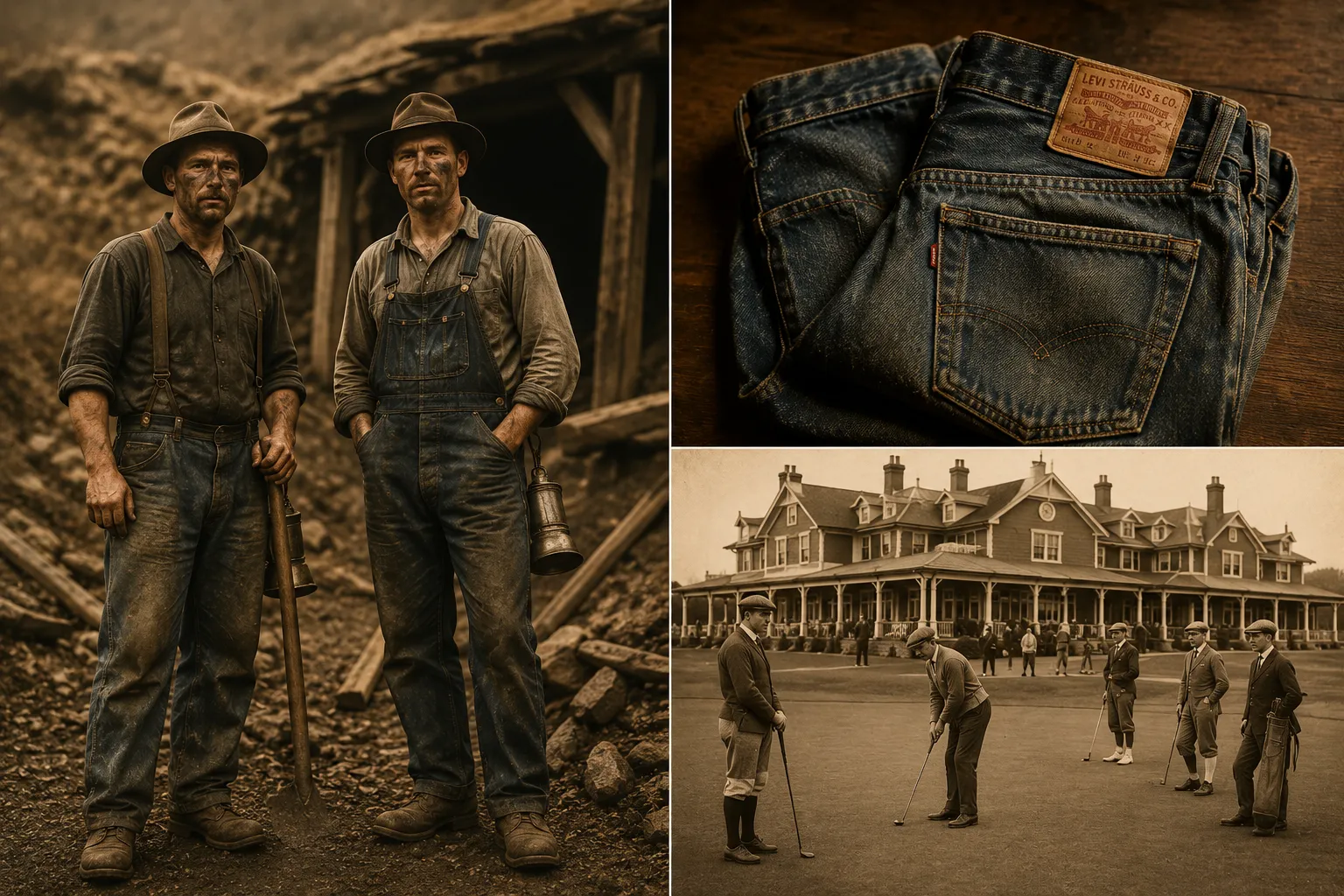
The clothing rules of many golf clubs stem from British elite clubs of the 19th and early 20th centuries. Jeans were the trousers of miners, farmers and factory workers back then, a history you can read at Britannica. On the golf courses of that era, clothing marked who belonged to society and who did not. Jeans stood on the wrong side of that line.
When we say today "no jeans, that's tradition", we are, perhaps without knowing it, carrying a piece of that old and often discriminatory sorting forward. I only ask myself a few questions along the way. Because golf tradition also long meant that women could not become members. The Royal & Ancient Golf Club of St Andrews admitted women for the first time in 2014, Muirfield followed in 2017. We were only too happy to let that tradition go and I have yet to meet anyone who mourns it. In the early years, golfers also played in jackets and ties, yet nobody demands the suit back. Apparently traditions are allowed to change. Which leaves the question of which ones we keep, which ones we let go and what we base that on.
What strikes me about the argument "no jeans, that's tradition" or "polo and chinos only" after thinking about it for a while: perhaps this is not actually a tradition in the proper sense at all. A look at the definition of the term "tradition" shows that it means the passing on of beliefs, convictions or patterns of behaviour across generations.
That only partially applies to golf clothing. It has changed again and again over the decades, from jacket and tie via knickerbockers to modern performance fabrics, colourful polo shirts, hoodies, short skirts and sneakers. Golf clothing was not preserved unchanged, it was continuously adapted to social developments and new materials. And precisely this constant change speaks rather against an unchanged tradition.
If Golf Clothing Is Cheap, Where Is the Barrier Then?
Golf clothing is available from expensive to cheap, a polo costs less than 30 euros at C&A. That may be true. Money is very probably no longer the big barrier for everyone.
Still, cost remains a barrier that limits access to the sport of golf. Every additional piece of clothing that has to be bought exclusively for one sport creates additional costs. Children, teenagers and families on a tight budget especially should have the chance to simply try golf without spending money on clothing first, and that should go beyond the taster lesson and the beginner's course.
If clothing of all things decides whether someone can even get to know the sport, then it is worth questioning that requirement critically.
Yet I have come to believe that the barrier was not the price tag all that often. Now imagine someone thinking about visiting a golf facility for the first time. The questions in the head of this potential new golfer are rarely "can I afford a polo shirt". More like: What do I even wear there? Will I stand out? Will they look at me sideways if I get something wrong? This insecurity costs nothing and can still weigh more than any green fee. A dress code, however harmlessly it is meant, sends a signal to newcomers: you are not really welcome here.

Why We Never Meet the Ones Who Were Scared Away
Right after that comes the next comment, one that falls in almost every one of these discussions and sounds completely plausible at first glance: "I don't know anyone who doesn't play golf because they can't wear jeans."
There is in fact an all too familiar thinking pattern in this sentence. Namely the so-called survivorship bias. The most famous example comes from the Second World War and I will tell it briefly, because it shows so beautifully how easily all of us fall into this trap.
The Allies examined their bombers returning from missions. The wings and fuselage were riddled with bullet holes and the obvious plan was to add extra armour exactly to those riddled spots. Sounds sensible, right?
That is where the aircraft gets hit the most, after all. The statistician Abraham Wald looked at the same machines and came to the exact opposite conclusion. Reinforce the spots where the returning planes have no holes. His reasoning, however, was: "These aircraft show precisely which hits a bomber can survive."
If a plane was hit in the wing, for example, it came home and was counted in the statistics. If there were hits to the engine or cockpit, the machine went down and never appeared in any analysis. The statistics consisted exclusively of survivors and consequently told only half the story.

Transferred to the clubhouse, this means that naturally only the people whom the dress code did not scare away are sitting there. Whoever was unsettled by the unwritten rules never came by the golf course.
He or she is at padel, at bouldering or at TopGolf and cannot appear in our perception at all. "I don't know anyone" could therefore be true and still reveal little about how many there are that golf has lost to old etiquette. How would we ever get to know them?
Does Clothing Say Anything About Character?
Another thought that stayed with me is the link between clothing and behaviour. The idea that someone who follows the dress code probably follows the other rules too. At least this claim appeared repeatedly in the comments under the Instagram reel.

I understand where the thought comes from, because I am only too familiar with the halo effect. Our gut likes to infer the inside from the outside, we all do it, every day.
But I have experienced both on the course. Impeccably dressed playing partners who generously overlooked their pitch marks. And people in casual clothes who repair every stranger's pitch mark along with their own. So what tells you more reliably about a golfer? The collar on the polo, or the state of the bunker after the golfer has left it?
Why a Polo and Not a T-Shirt, Anyway?
A golfer in the comments asked this question too. What exactly does the collar on a golf shirt do? The best functional argument I found is that you can flip it up and it then protects you against the relentlessly burning sun.
Golf is an outdoor sport and UV protection is an important topic on the course. I even like that one. But then the logical consequence would be "collar recommended" and not "t-shirt forbidden". Nobody makes sunscreen mandatory either. In the end, clothing should be comfortable and fun. The rest is taste and taste is a wonderful thing to chat about, ideally though without a prohibition sign.
And the Fear That Everything Tips Over Afterwards?
Behind many voices from the comment section there is, I believe, a genuinely meant worry. Once the jeans are here, what comes next? Sweatpants, slides, in the end no beginner's certificate at all? (And would that really be so bad?)
The worry is about a familiar place possibly changing. So it is, after all, a worry that is all too human and understandable.
Two observations reassure me. Facilities that have relaxed their dress code do not, from everything I can see, sink into chaos. They simply have more people on the range and the course. And every facility keeps its house rules for the unlikely case of the bathrobe. On top of that comes a hint from one commenter that I like to pass on: without the beginner's certificate there is no golf anyway. In Germany and Austria, you need to pass the "Platzreife" before you are allowed on most courses. The sport has long had a filter and it tests your ability and your behaviour, not your wardrobe. (Though here too, we can happily debate whether this filter is even necessary anymore.)
"But Almost Everyone Does It This Way"
Jeans would not be allowed on 95 percent of courses worldwide, one comment said. With 42,000 golf courses worldwide, I cannot verify the number. But let us assume it for a moment. I then only ask myself what exactly this classification is supposed to tell us.
That many facilities handle it this way shows, first of all, that many facilities handle it this way.
Thirty years ago there was probably also no woman on the board at 95 percent of the clubs. Prevalence tells you a lot more about habit and very little about whether a rule still does today what it was once meant to do.
Looking at other habits of past times, it quickly becomes clear how long many of them lasted and how speechless they leave us today.
Until 1977, married women in Germany sometimes needed their husband's permission to take a job. For many decades, women could neither vote nor study nor practise numerous professions. Homosexuality was a criminal offence in many countries and was officially classified as a mental illness until 1990. Child labour was taken for granted. Corporal punishment was part of everyday school life. Left-handed children were retrained against their will. Doctors recommended cigarettes. Smoking was completely normal on planes, in hospitals and in restaurants. Asbestos was considered a miracle material. Lead was in petrol and paint. Seat belts were not mandatory. Drink-driving was viewed far more casually by society.
Let us go back further. People were legally segregated by skin colour. Black people had to attend different schools, use different entrances and sit in different places. In South Africa, apartheid was state law. In many countries, women were legally subordinate to their husbands. People with disabilities were isolated instead of integrated. Forced sterilisation was legal in several countries. Eugenics was considered progressive science. Colonial powers declared foreign continents their property. Millions of indigenous people were displaced, disenfranchised or killed.
Let us go back further still. Slavery was completely legal in large parts of the world for millennia. People were bought, sold and inherited like property. Public slave markets were part of everyday life. Torture was an accepted instrument of justice. Public executions drew thousands of spectators. Alleged witches were burned. People were persecuted and executed for their faith. The Inquisition justified torture in the name of truth. Comparatively minor crimes carried the death penalty. Duels were considered honourable. Blood feuds were socially accepted.
The further back we go in history, the more extreme the examples become. Almost all of these things were social consensus. They were considered normal.
That is exactly why the statement that something is handled a certain way on 95 percent of golf courses is no proof that it is sensible or in keeping with the times. It merely describes how widespread a habit is. History shows again and again that precisely the greatest errors of their time were carried by the majority. A modern and enlightened society does not evolve by preserving every tradition. It evolves by having the courage to question outdated rules and to measure them against whether they still serve a comprehensible purpose today.
What Would the Golfers of the Past Say About Us?
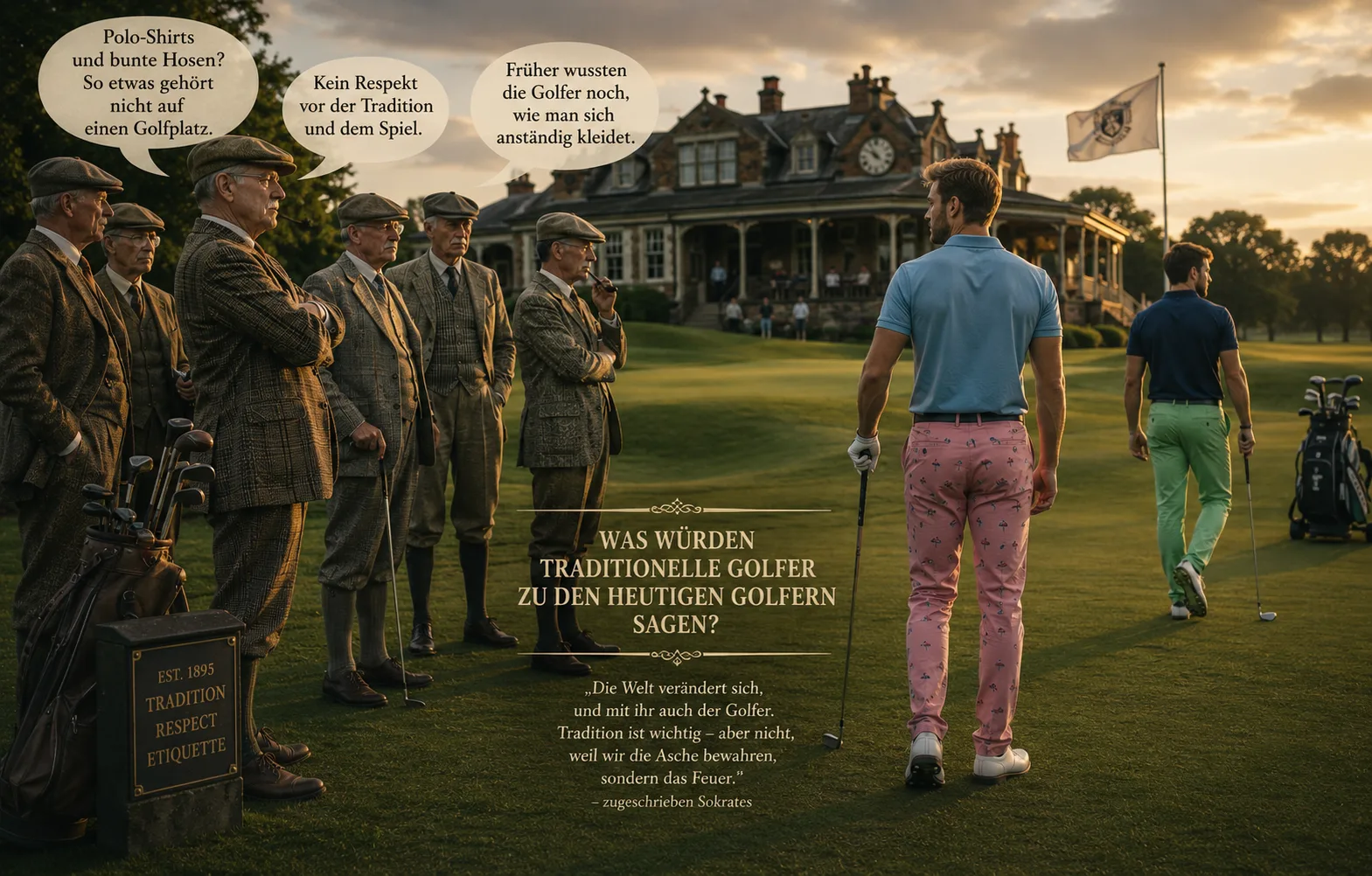
With all these questions about tradition, I eventually started a thought experiment. Imagine a golfer from 1975 or even 1925 suddenly standing on a course today. He sees loud colourful outfits, shorts, sneaker-style golf shoes, tour pros in hoodies and a music box on the cart. I suspect he would shake his head at quite a lot of what even the strictest defenders of the dress code consider completely normal today. The jeans would probably be the least of his problems.
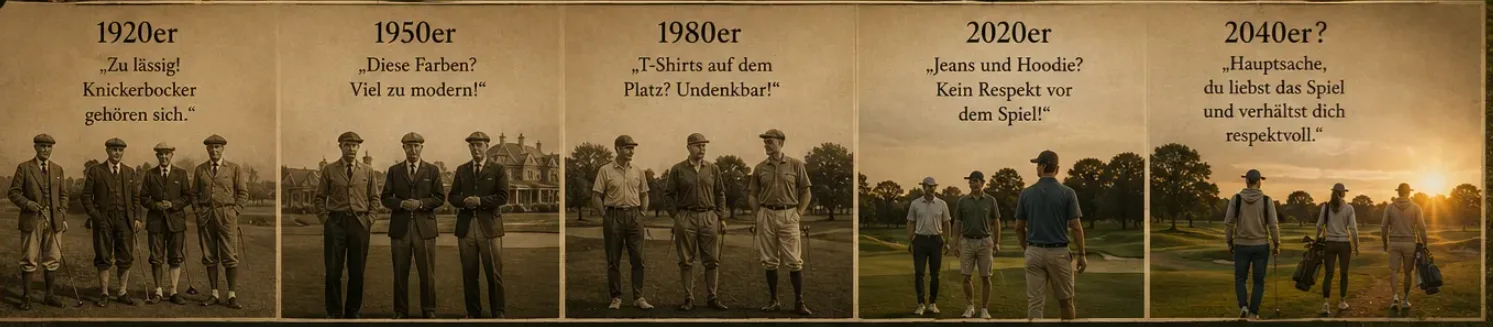
The further back I look, the clearer the pattern becomes. In the 1920s, knickerbockers and tweed were proper, anything else was too casual. In the 1950s, the first bright colours raised eyebrows. In the 1980s, t-shirts on the course were unthinkable. Today we debate jeans and hoodies. The outrage seems to remain constant through the decades, only its piece of clothing changes over time.
What will be on the index in 2040? And what will the golfers of 2075 smile about when they dig up our comment sections?
The complaint about the disrespectful younger generation is, by the way, so old that it is even attributed to Socrates. The famous quote about the youth who "love luxury and have bad manners" almost certainly does not come from him, it was put into his mouth much later. The same goes for the lovely sentence that tradition is "not the worship of ashes, but the passing on of fire". Sometimes it is attributed to Socrates, sometimes to Gustav Mahler, and it probably comes from neither of them.
If there is something to the fire sentence, the only question for our topic would be: what is the fire in golf and what are the ashes? The love of the game, the honesty, the consideration, the raking of the bunker. Or the stuff that true trousers are made of.
Golf Is Not Alone. A Look at Other Sports
In case you think only golf has these debates, here is a little tour. Almost every sport has its clothing conflict behind it or is still right in the middle of one.

In beach volleyball, the world federation FIVB long prescribed extremely skimpy bikini bottoms for the women, including a maximum side width. Only in 2012 were shorts and long sleeves allowed, among other things for cultural and weather reasons. In beach handball, the Norwegian women's team was fined in 2021 for playing in shorts instead of bikini bottoms. After worldwide protest, the musician P!nk even offered to pay the fine, the rules were changed. The German gymnasts competed at the Tokyo Olympics deliberately in full-body suits to decide for themselves how much body they show. In tennis, Serena Williams wore a catsuit at the 2018 French Open, whereupon the French federation declared that "the game and the place" were to be respected. Formula 1 said goodbye to its grid girls in 2018 because the image no longer fit the times.
And this is not purely a women's topic. The NBA imposed a strict business dress code on its players in 2005, no baggy clothes, no chains, no durags, which many perceived as pushing back hip-hop culture. The New York Yankees held on to their beard ban for almost 50 years and only relaxed it in 2025. Lewis Hamilton publicly took on the FIA in 2022 when it wanted to ban his jewellery in the cockpit. In football, long hair, earrings and colourful boots were once considered unprofessional, until players like Beckham and Neymar simply rolled over those norms. In rugby, there were arguments about traditional tight shorts, modern performance clothing and headwear. Only Olympic skateboarding stayed demonstratively relaxed, baggy clothes simply belong to its identity.
During all of these debates, it was almost never about function. It was about who gets to decide how a sport looks to the outside. The directions differ, in golf many chafe against formal codes, female athletes often fought against overly skimpy requirements and marketing. The core of the conflicts still feels strongly related to me. Athletic clothing becomes a proxy here for a much bigger problem: who owns the image of a sport?
The Irony of Modern Golf Fashion
And now comes the part that made me smile the most during my research. While comment sections argue about jeans, high-priced golf fashion has long been selling hoodies for several hundred euros, sneaker-style golf shoes and even sleeveless tops.

On tour, pros walk around in outfits that would have given any club secretary a sweat twenty years ago.
An expensive hoodie with a giant logo now counts as golf-appropriate in many places. A plain pair of dark jeans does not. I searched for the athletic difference for a long time and found no really good explanation for it.
What I found instead is a symbolic reason. The polo shirt and chinos come from above, from luxury streetwear. Jeans historically come from below, from the factory. Perhaps they have never quite shed that origin in some minds.
What It Might Really Be About
The longer I spent with the topic, the more I had the feeling that several unspoken layers lie beneath this debate.
Golf is searching for its identity. The sport wants to become younger, more modern and more accessible while staying exclusive, premium and tradition-conscious. Both at once is hard. Perhaps the jeans debate is above all a symptom of this inner balancing act.
Change feels like loss. When a familiar place transforms, people lose a piece of predictability and orientation. Small symbols can then become emotionally huge. Perhaps behind the fuss about jeans lies, for some, the quiet worry that "their golf" is disappearing. That is a very human feeling and I think we are allowed to take it seriously, regardless of where we stand on the trousers.
Rituals create meaning. Not every rule exists because of its usefulness. Rituals create atmosphere and belonging. Whoever values the dress code perhaps in truth values this feeling. I would find that a very honest and likeable argument, by the way, much stronger than any discussion about fabric.
And respect does not mean the same thing to everyone. For one generation, respect means formal clothing, conformity, visible discipline. For the next, respect means behaviour, consideration, authenticity. Both mean it seriously. They just use the same word for different things. If that is true, then in the comment sections it is simply two definitions of respect talking past each other.
It always gets interesting when a culture suddenly has to explain why its rules exist. Many norms work wonderfully for decades as long as nobody questions them. As soon as someone asks "what problem does this rule actually solve?", it gets either quiet or loud. Under the Frauenthal post, it got loud.
And What Does That Mean for the Next Generation?
At this point I briefly leave the observer's role, because this is about the future of our industry. Golf in Germany has a youth issue and an image issue. To survive, golf facilities need enough members or green fee players, the maths is that simple. Every barrier at the entrance, whether real or only perceived, costs potential golfers. And the image of an elitist sport is one of the biggest perceived barriers of all.
What does someone to whom golf is entirely foreign think, someone who is just considering booking a taster lesson for the very first time and finds this post with all its comments on Instagram? I don't know. I only know that the same comment section also contained conciliatory thoughts. One suggested promoting the beginner's course instead and showing that sneakers and jeans are perfectly sufficient for it. Another wrote that he is happy about every first-timer who shows up in comfortable everyday clothes. There it is, the common ground. At the beginning, what counts is that people come to the golf facilities at all. Whoever catches the golf bug usually buys the polo later all by themselves. Simply because they want to.


For operators, the dress code is ultimately a positioning question. An exclusive golf & country club with a waiting list can afford a strict dress code, it is part of the product there. A public facility fighting for every green fee player may pay for the same dress code with empty tee times. There is no single right answer, but it is worth turning a habit into a conscious decision.
Who Decides About Jeans on the Golf Course in the End?
In the end I arrive at the most unspectacular of all answers. It depends on where you play. A private country club in the USA, a facility in the Arab world, a Scottish traditional club and a public 9-hole course in the German Ruhr area are deeply different worlds with differing expectations. Every golf facility decides for itself what goes into its house and dress rules. That is also its good right and this article does not want to shake that (too much) either. If your club requires polo shirts, wear a polo shirt there or find a facility that sees it more relaxed. Both are completely fine.

In exactly the same way, it is Schloß Frauenthal's good right to say, jeans and t-shirts are welcome here. Nothing was taken away from anyone. Strict clubs stay strict, the polo stays allowed, the pleated trousers stay ironed. A single facility in Styria merely said, things can be different here. Why does the debate still feel to some like a loss that triggers such strong emotions? I believe whoever answers that question for themselves understands the entire debate.
The Practical Part: What You Want to Know Before Your Round
Enough philosophising. If you are standing in front of your wardrobe right now, here are the answers to the questions asked most frequently around jeans and golf.
How Do I Know Whether a Facility Allows Jeans?
A look at the website almost always helps, the dress code is usually found under "dress code", "etiquette" or in the course rules. If you find nothing, call the office briefly, it takes a minute and spares you any insecurity. As a rough rule of thumb from my experience: the more public and the younger the facility, the more relaxed the dress code. Private traditional clubs and tournaments are stricter.
Does the Dress Code Also Apply on the Driving Range?
On most facilities the range is noticeably more relaxed than the course, often no formal dress code applies there at all. For taster lessons, almost everywhere: just come in comfortable sportswear and sneakers. At TopGolf, indoor facilities and simulators, clothing plays practically no role anyway.
What Do I Wear to a Beginner's Course?
Comfortable, movement-friendly clothing and clean sneakers are completely sufficient for the beginner's course on the vast majority of facilities. You can buy golf shoes and golf clothing once the bug has caught you, before that it would almost be a waste of money. When in doubt, the golf school will answer the question in advance.
Are Black or Dark Stretch Jeans More Accepted?
From my observation, yes. Where facilities relax their rules, it is usually well-kept, dark jeans without holes and without washes that get accepted first. Dark stretch jeans with a polo look completely inconspicuous on many courses. That is not a guarantee, the house rules of the facility always have the final say.
What Happens If I Show Up in Jeans Anyway?
The range goes from "nobody says anything" through a friendly hint to a loaner polo from the pro shop. On strictly run facilities it can also be expulsion from the course, the house rules allow it and individual clubs enforce it. So better check briefly beforehand, then you start your round relaxed.
Which Trousers Do I Wear When Jeans Are Taboo?
Plain chinos or light golf trousers are the most uncomplicated way, both are available from around 20 to 30 euros, at any high street store. It does not have to be a golf brand, a collar on the shirt and trousers without holes are enough almost everywhere. They should be comfortable, after all you will walk in them for several hours.
And on a Golf Trip?
Resorts and public courses in the USA, Spain and Portugal I usually experience as more relaxed than German traditional clubs. In Great Britain the range is huge, from the laid-back links course to the club with a jacket requirement in the clubhouse. In the Arab world and in classic country clubs, things tend to be more formal. So that one look at the club website simply belongs to travel planning. If the topic of golf travel grips you in general, I have written a whole book about it. In "Golftourismus, your guide to golf trips" (in German) you will find, alongside dress code questions, everything about planning, destinations and everything else around your next golf trip.
My Conclusion. It Was Probably Never Only About the Jeans
What do I take away from this journey? The rules of the sport are silent on clothing. The material question has largely been settled by modern fabrics. The history of jeans tells more about society and outdated thinking patterns than about the fabric itself. And behind the loudest outrage there is, I believe, often simply the love of a game that casts such a strong spell on all of us.
I can understand that. I only wish we would talk about exactly that, about belonging, about rituals, about the future of our sport. And not (only) about denim.
The longer I researched jeans in golf, the less it was about trousers and the more it was about the question of how groups decide who belongs.
To close, I leave you alone with the questions that have accompanied me since that comment section. Why does a pair of jeans touch us emotionally more than slow play or a trampled green? Why does expensive streetwear count as golf-appropriate in many places, but classic workwear does not? How many unwritten rules do we only notice when someone breaks them? And where exactly runs the line between well-kept etiquette and quiet access control?
I have found my answers. Yours belong to you. And if we ever meet on a round, you will probably not recognise me by my trousers, but by the fact that I repair other people's pitch marks along the way too.
For the Curious: What Psychology Knows About This
If, while reading, you had the feeling of recognising these patterns from entirely different debates, you are not alone. Social psychology has had names for much of this for decades. I will introduce the mechanisms to you in general terms, the way they appear in any textbook. You have already met the survivorship bias further up. Whether and where the rest applies to golf, I leave entirely to you.
The status quo bias. People often prefer existing rules simply because they already exist. A rule automatically feels normal, right and self-evident, even when hardly anyone can explain its original purpose anymore. A question that follows from this: how many rules in our everyday lives are genuinely useful and how many exist simply because they have been there for a long time?
The ingroup bias. We unconsciously favour people who seem similar to us, know the same codes and use the same symbols. A dress code can work like a group signal in this. Whoever intuitively knows what is "appropriate" automatically seems like a better fit.
Cultural capital. The sociologist Pierre Bourdieu described how social groups mark belonging through more than money. Language, taste, behaviour, clothing, all of that is knowledge you either bring with you or you don't. Access to a group can then run through unwritten codes. Whoever knows the codes moves effortlessly with the group. Whoever has to learn them first feels at every corner that they are new and unwelcome.
The salience bias. People weigh visible things more heavily than more important, but invisible things. Conspicuous trousers can be seen by everyone from 200 metres. Whether someone plays slowly, you only notice after three holes. Whether someone ignores pitch marks, often only the greenkeeper sees the next morning. The visible gets our emotions, the invisible gets our leniency.
System justification. People tend to defend existing systems because stability provides psychological safety. Whoever has learned over decades what a world is supposed to look like, for them change feels wrong at first. Entirely independent of whether a practical reason for the old order still exists.
The halo effect. We automatically transfer outer impressions onto character traits. "Well dressed" quickly becomes "respectful, serious, competent" in our heads. And vice versa. Research has described this pattern for over 100 years and it explains rather well why clothing can trigger such strong feelings, although it reveals little about a person's behaviour.
Symbolic boundaries. Sociology describes how groups often define themselves through what counts as fitting, tasteful and respectable. Clothing then becomes a social filter, without officially being one. Perhaps that is the quietest and at the same time most effective mechanism of all.
Perhaps a modern dress code no longer works like a prohibition at all. But like a quiet test of who already knows the cultural codes.
Frequently Asked Questions About Jeans and Golf Dress Codes
Are jeans officially forbidden on golf courses?
No. The official Rules of Golf by the R&A and USGA contain no clothing requirements whatsoever. Whether jeans are allowed is regulated exclusively by the house or dress rules of the individual facility. When in doubt, a quick look at the website or a call to the office helps.
What actually belongs to golf etiquette?
Since 2019, the former etiquette in the rule book has been called "Standards of Player Conduct" (Rule 1.2). It covers integrity, consideration for others (safety, prompt play, shouting "Fore!") and care for the course. Clothing does not appear in it and did not appear in the old etiquette section either.
Can a club send me off the course because of my clothing?
Yes. Every facility can set its own clothing rules through its house rules or a code of conduct and enforce them, up to expulsion from the course or, in tournaments, disqualification. So the rule is: inform yourself in advance about the rules of the facility you are playing.
Why do some clubs ban jeans of all things?
The roots lie in British elite clubs of the 19th and 20th centuries. Jeans counted as workwear and marked the "wrong" milieu. Today's justifications such as material or appearance mostly came later, the strongest factor remains habit and the familiar image of the sport.